After more than three years of collaboration, innovation, and hands-on testing, the Farmtopia project is concluding with a clear message: digital farming can be accessible, affordable, and practical for small and medium scale farms.
Funded by the Horizon Europe Programme, Farmtopia set out to democratise digital farming by addressing the barriers that have long prevented smallholders from benefiting from Agricultural Digital Solutions (ADSs). Throughout the project, a consortium of 22 partners worked together with farmers, researchers, technology providers, advisors, and innovation actors to develop solutions tailored to the real needs of Europe’s agricultural community.
Testing in Real-World Conditions
At the heart of the project were 18 Sustainable Innovation Pilots (SIPs), 9 pre- selected and 9 selected through the Open Call. Together, the pilots involved 62 farms across 19 countries, covering 10 agricultural sectors and 18 crops and agricultural products. These real-life demonstration sites provided valuable environments for co-creating, testing, and assessing the performance of Agricultural Digital Solutions (ADSs) in collaboration with farmers and key digital innovation actors under diverse farming conditions, covering multiple agricultural sectors and crop types. From avocado and mushrooms to sheep and goat farming, hemp, arable crops, carrots, dairy, olives, almonds, plums and vineyards, the pilots addressed a wide range of challenges faced by European farmers. The solutions tested were equally diverse. Farmtopia explored technologies including smart irrigation, artificial intelligence, IoT sensors, Earth Observation and satellite data, drones, computer vision, precision spraying, digital farm management, digital traceability, greenhouse gas monitoring and others.
“What makes the results of Farmtopia particularly encouraging is that they go beyond testing technology – they show measurable benefits in real farming conditions. Across our pilots, digital solutions helped farmers reduce water, fertiliser and pesticide use, lower costs, improve productivity and make better-informed decisions. From saving up to 70% of water in avocado production to reducing fertiliser use by almost 24% in arable farming, the results demonstrate the real potential of digital tools when they are designed around small farmers’ needs. This is the kind of practical, farmer-centred innovation that can help make European agriculture more sustainable and resilient.”
Dionysios Solomos, Project Coordinator, NEUROPUBLIC
Tools Designed with Farmers
Farmtopia placed farmers at the centre of digital innovation, involving them and other stakeholders in the co-creation, testing and validation of solutions through consultations, demonstrations, Open Days and other activities. This ensured that the technologies addressed real farming needs and were practical to use. User feedback was consistently positive, with solutions receiving satisfaction ratings of 8/10 on average.
Farmtopia Open Call
Farmtopia’s Open Call for Innovation expanded the project with 9 additional Sustainable Innovation Pilots, bringing new farmers, technologies, crops and countries into the project. The call attracted 124 applicants, with nine winning consortiums ultimately selected. Each winning consortium (SIP) brought together an SME and a farm.
A total of €900,000 in financial support was distributed, with €100,000 delivered to each selected SIP. The supported pilots introduced digital solutions for areas including vegetable production, viticulture, kiwi and olive farming, medicinal plants, plum and almond production, citrus production and more.
Policy and Regulatory Recommendations for Smallholder Digital Inclusion
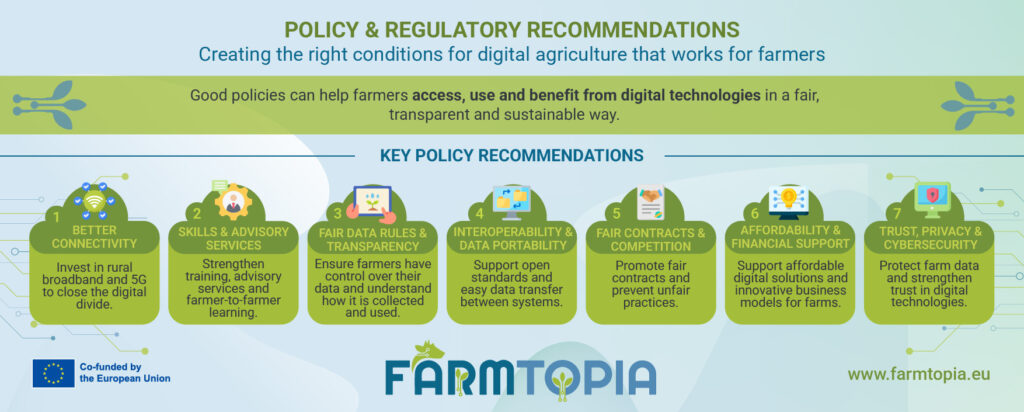
Farmtopia also developed evidence-based policy and regulatory recommendations to help make digital farming more accessible to small and medium-sized farms. Drawing on experience from its 18 Sustainable Innovation Pilots (SIPs), stakeholder consultations and the project’s Policy Workshop in Brussels, the recommendations address key barriers to digital adoption, including connectivity, digital skills, access to advisory services, data ownership, interoperability and fair contractual conditions. They call for stronger farmer control over agricultural data, greater transparency and improved access to the infrastructure and support needed to benefit from digital technologies.
A New Code of Conduct for Technology Use and Data Governance in Agriculture
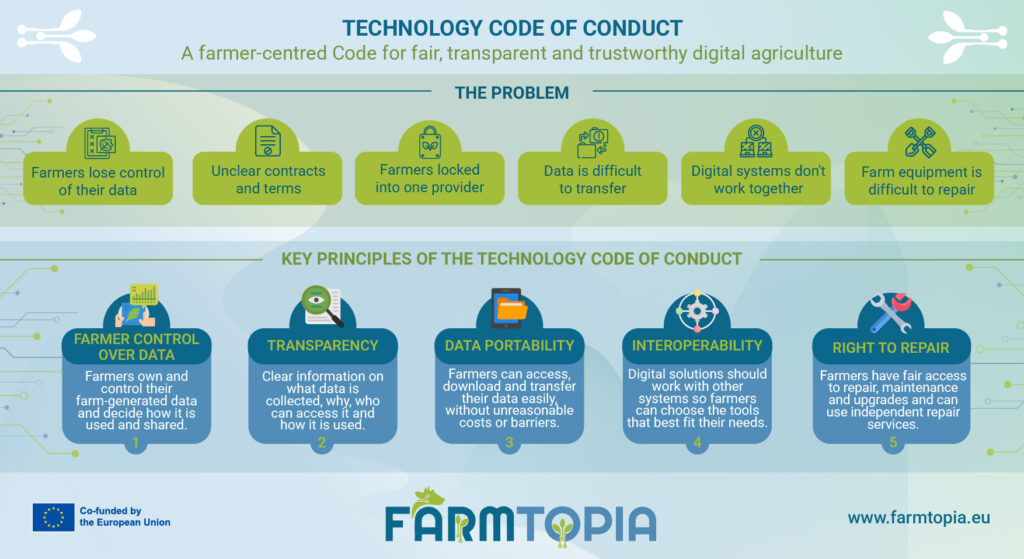
Complementing these recommendations, Farmtopia developed a farmer-centred Technology Code of Conduct to promote more transparent, fair and responsible use of digital technologies in agriculture. The proposed Code brings together principles covering data governance, interoperability, data portability, cybersecurity, privacy, fair contracts, right to repair, liability and benefit-sharing. Developed through stakeholder input and analysis of existing European legislation and initiatives, it provides practical guidance for farmers while encouraging technology providers to build solutions that give users greater control, clearer choices and stronger protection.
Stay Connected
Farmtopia’s work leaves behind practical tools, tested solutions and recommendations to support a more inclusive digital future for European agriculture.The Farmtopia project has received funding by the European Union’s Horizon Europe research and innovation programme. All the information is available on the project’s website, as well as Facebook, Linkedin, Twitter and Youtube.